Hanging a picture may seem like the simplest of all home improvement projects. While it is quite easy, there are factors like wall type and object weight that you need to consider before hammering away. If you’re a beginner or if you’ve hung pictures before but always done some in a hit or miss kind of manner, these tips will come in useful.
The first thing you need to do is purchase the right fasteners for your picture and your walls. The most common fasteners for hanging things are picture nails and hooks. While these are the most common type of fastener, they are not the most appropriate or effective ones to use in all cases.
 If you are going to hang anything on a concrete, stucco or brick wall, then you should not try to use a regular nail. A concrete screw will securely anchor your object and will prevent you from chipping the wall’s surface. If you use a nail in a concrete or stucco surface, you can end up removing chunks of the wall around the nail when hammering.
If your object is heavy, then you might want to insert a plastic anchor or molly bolt-for fastening into the hole to ensure that there is no damage to your wall. Make sure that you are using the right type of fastener for your wall surface.Once you’ve figured out the type of wall surface and the most appropriate fastener to use, you will need to decide on placement.
It’s About Height
The first thing you want to decide is how high you want to hang the object. The basic rule of thumb is to hang pictures so that the center of the picture is at eye level. Have someone hold a tape measure against the wall and then stand back and see what number is at your eye level – that’s where the center of your picture should be.
Once you decide on the height on the wall, you need to measure the picture itself to determine the mounting height. You will then measure from the bottom of the picture to the highest point of the hanging wire. You can then figure out the hanging height by subtracting half of the picture’s height and adding the difference of the eye-height level you measured before.
Your measuring isn’t done yet though. You want to take that figure and measure that distance on the wall so you can make a mark where the bottom of the hook will hit. After you have that vertical mark, you want to measure horizontally to ensure that your picture is in the center of the space. Next you will mark where the vertical and horizontal lines cross.
Holding the faster in place, you will nail or screw the fastener into the wall. After the nail or screw is in place, you want to carefully hang the object on the wall. Make sure you are careful not to mark or scrape the wall with the frame.
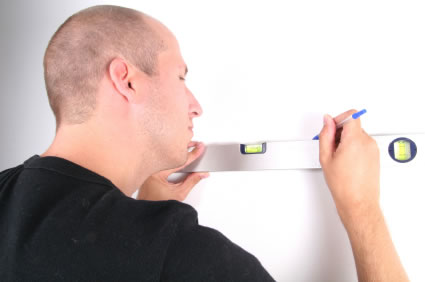 Once the picture is on the hook, you should step back to see whether it is level. You can shift the picture to either the left or the right to adjust the level.
If you find (after hanging) that the picture is either too low or too high, you can adjust the wire on the back of the picture rather than making a new hole.
If you are planning on hanging multiple pictures and/or objects on one wall, then you want to plan out your measurements very carefully. Start by holding up your pictures or laying them on the floor in the pattern you want. Measure the wall space and measure each picture to ensure that you have enough space. You want to make the vertical and horizontal marks for each picture rather than just guessing. It is often easier to offset the pictures when you estimate. If you do want all of the pictures even, then you need to use a level and be really exact in your measurements. A laser level can be useful in these types of situations.
Don’t be intimidated with all of these steps if this is your first time hanging a picture. Taking your time and doing all the prep work outlined above will ensure that your picture is centered, level, and really adds character to your space.